

Categories
- All blogs (2)
- Sap Business One (4)
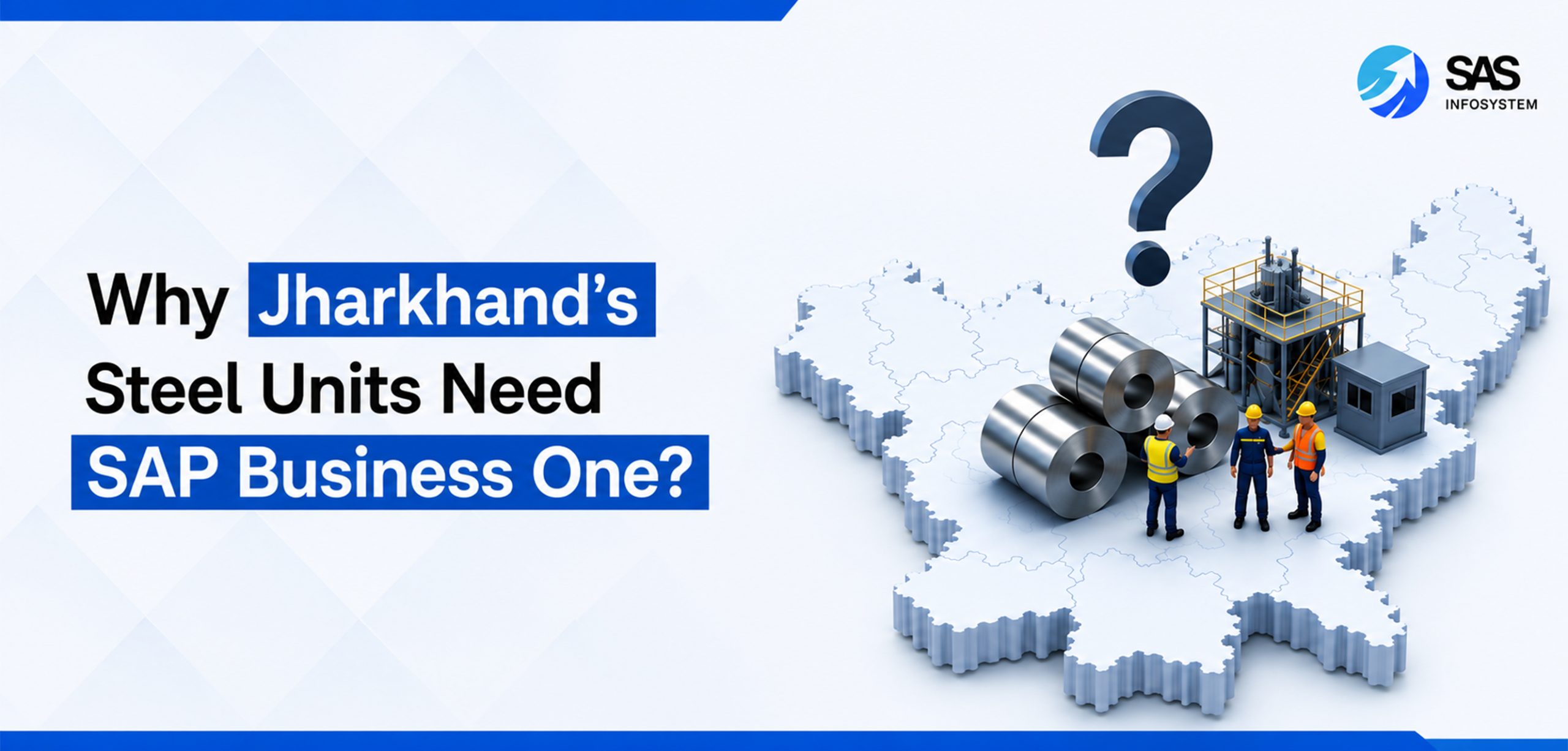
Why Jharkhand’s Steel Units Need SAP Business One?
Jharkhand has been at the heart of India’s iron and steel industry for decades, home to everything from large integrated plants to a dense cluster of small and mid-sized rolling mills, sponge iron units, and steel fabricators. As demand grows and raw material costs stay volatile, the units that are pulling ahead aren’t necessarily the ones with the biggest furnaces — they’re the ones that know exactly what’s happening on their shop floor, in their stores, and on their books, every single day. This is where SAP Business One comes into the picture.
The Challenge of Running Steel Operations on Disconnected Systems
Most steel units still run on a patchwork of tally-based accounting, Excel-based production logs, and separate registers for scrap, yield, and quality rejection. This creates a few very specific, very expensive problems:
• Raw material costs (iron ore, scrap, coal, ferro alloys) fluctuate constantly, but purchase and consumption data often sit in different systems, making true input cost hard to pin down.
• Yield and melting loss are tracked manually, so a slow drift in furnace efficiency can go unnoticed for months.
• Multiple furnaces, rolling mills, or plant locations each keep their own version of stock and production data, with no single view for management.
• Statutory compliance — excise, GST, e-way bills — becomes a scramble at month-end
instead of a byproduct of daily transactions.
None of these problems are new, but they get more expensive as a unit grows — a 5% yield loss that was tolerable at one furnace becomes a serious drag on margin once a business is running two or three.
How SAP Business One Addresses These Gaps?
An integrated ERP like SAP Business One brings procurement, production, quality, and finance onto a single platform, so decisions in a steel unit are based on current numbers, not last month’s reconciliation.
In practice, this means:
Raw material purchase, receipt, and consumption are linked directly to production batches, so input cost per tonne is visible as it happens.
• Melting loss and yield are calculated automatically against standard norms, with exceptions flagged instead of buried in a register.
• Multi-location and multi-furnace operations report into one consolidated view, so plant heads see their own numbers and management sees the whole picture.
• GST, e-way bill, and other compliance requirements are built into the transaction flow, reducing the month-end scramble.
• Quality rejections and customer complaints are tracked against batches, making root-cause analysis possible instead of guesswork.
A Sector That Rewards Discipline
Iron and steel is a sector where small inefficiencies compound quickly — a slightly higher scrap rate, a slightly delayed purchase decision, a slightly late compliance filing all add up over a year of high-volume, low-margin production. This is one of the recurring patterns SAS Infosystem sees across manufacturing businesses in Jharkhand and the wider Eastern belt: the units that formalise their processes into an ERP early are the ones that stay disciplined as they scale, while others keep firefighting the same issues year after year.
Moving to an ERP doesn’t mean replacing every process overnight. Most steel units start with the areas causing the most pain — usually raw material costing or production yield tracking — and expand into finance, quality, and compliance from there.
Getting Started
With over 20 years of ERP implementation experience, SAS Infosystem works closely with manufacturers to map SAP Business One to how a steel unit actually operates on the ground, rather than forcing operations into a generic template.
If yield loss, raw material costing, or compliance is currently a manual headache in your plant, talk to our team about how an integrated ERP solution like SAP Business One can help.